
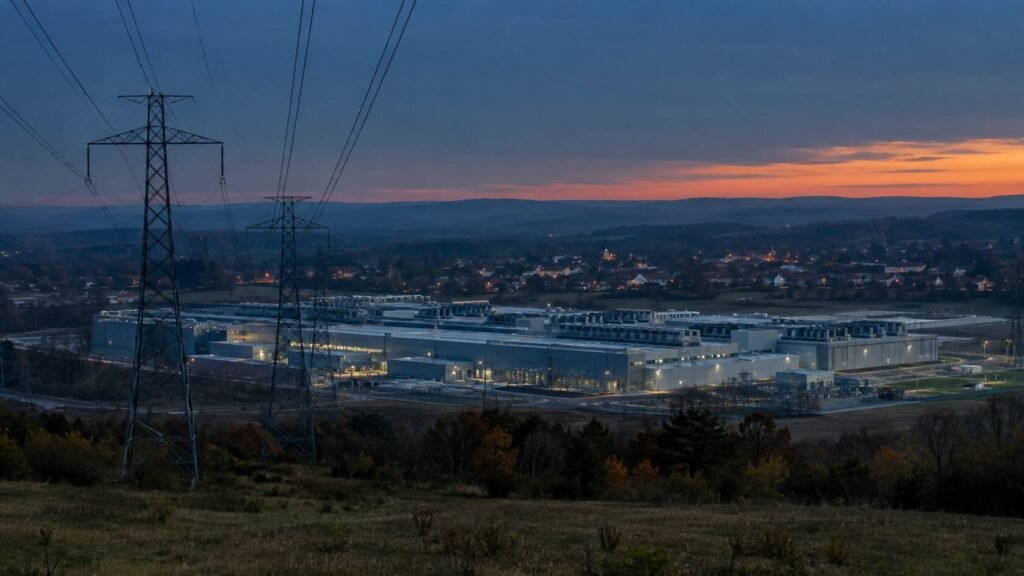
Every time you ask a chatbot a question, a computer somewhere wakes up and starts using power. It sits in a huge building full of servers, fans and cables. That building is a data center, and data center electricity use never stops, day and night.
For years, nobody worried about this. Now AI is growing so fast that energy experts in the United States are asking a new question: will there be enough power for everyone in the 2030s?
I use AI tools almost every day: to check my English, to find ideas, to plan a trip. And honestly, I never thought about where the energy for all these answers comes from. So I decided to look at data center electricity use, and what it means for the rest of us.
How Much Data Center Electricity Does America Use?
Today, data center electricity makes up about 4–5% of all power used in the United States, according to the research institute EPRI. That already sounds like a lot. But the forecasts for the next few years are much bigger.
- EPRI says data centers could use 9% to 17% of US electricity by 2030. Its new range is 60% higher than its earlier forecast.
- Berkeley Lab, which works for the US Department of Energy, expects about 12% by 2030 in its June 2026 report.
- The International Energy Agency says data centers will cause nearly half of all growth in US electricity demand until 2030.
To imagine the size: one typical AI data center uses as much electricity as about 100,000 homes, says the IEA. And companies are building hundreds of them.
In about five years, data centers may go from one in twenty units of US electricity to one in ten, or even more.
Why the grid may not keep up
The problem is not only how much data center electricity AI needs. A data center can be built in one or two years. A new power plant or a big power line often takes five to ten years.
The organization that watches the safety of the North American grid, NERC, gave a clear warning in its assessment from January 2026:
- Peak electricity demand in summer may grow by 224 gigawatts in ten years. That is 69% more than NERC expected just one year earlier.
- 13 of 23 regions face an elevated or high risk of not having enough power in the next five years.
- By around 2028–2030, NERC sees high risk in some of the biggest regions, including PJM (13 states in the East), MISO (the Midwest) and ERCOT (Texas).
At the same time, many old coal and gas plants are closing. New supply, like gas plants, solar farms and batteries, is coming, but often not fast enough. This gap between fast demand and slow supply is what people call the coming power crunch.
It does not mean the lights will go off everywhere. It means the system will have less room for error, especially on very hot or very cold days.
What it means for ordinary people
You may never visit a data center, but you may still pay for data center electricity.
In the PJM region, the grid holds an auction every year to make sure there will be enough power plants in the future. A few years ago the price was about $29 per megawatt-day. In 2024 it jumped to about $270, and in 2025 it hit the maximum allowed, about $329. Experts link this mostly to fast demand growth from data centers and old plants closing, as the Ohio Capital Journal reports.
PJM itself expected household bills to rise by 1.5% to 5% after the last auction. That is not a disaster for one family. But it is a new kind of cost: people pay for the energy of machines they do not own.
There is also the question of reliability. If the grid has less spare power, a heat wave or a winter storm becomes more dangerous. Blackouts in extreme weather are the risk that NERC worries about most.
In my opinion, this is the part we should talk about more. If a company earns money from AI, it should pay for most of the new power plants and power lines it needs. Families should not pay for it with their monthly bills.
What is being done
The good news: everyone sees the problem, and there are several answers.
- More power plants. According to EPRI, natural gas will cover most of the new demand in the next years, together with solar, wind and batteries.
- Old nuclear plants coming back. Microsoft signed a 20-year deal to restart a reactor at Three Mile Island in Pennsylvania. It may be back online in 2027.
- Smarter data centers. New chips and cooling systems do more work with less energy. Some data centers can also slow down at peak hours to help the grid.
- Tech companies paying their share. Some states and grid operators now ask big data centers to pay more for the new lines and plants they need.
None of these is fast or simple. That is why the next five to ten years matter so much.
Think about it
AI feels light and invisible. We type a question, and an answer appears in seconds. But behind that answer there are real buildings, real power lines and real bills.
Data center electricity is becoming one of the biggest questions of this decade. The 2030s will show whether America can grow its AI and keep the lights on for everyone at a fair price. Maybe the real question is not “Can AI do it?” but “Who pays for the energy?”
What do you think: should we use AI less, or build more power? Tell me in the comments.
As for me, I will not stop using AI. But next time I ask a chatbot something silly, I will remember that somewhere a power plant is working for my question.
Data centers are only one side of the story. If you want to see how AI already shapes ordinary days, from maps to spam filters, read my next piece.
Sources (checked October 2026)
- EPRI — Powering Intelligence 2026
- Berkeley Lab — United States Data Center Energy Usage Report: 2025 Update (June 2026)
- IEA — Energy and AI, executive summary
- POWER Magazine — NERC warns long-term grid reliability risks mounting
- Ohio Capital Journal — electric bills rising as data center demand continues
- DatacenterDynamics — Three Mile Island restart ahead of schedule